
AI Chatbot
Comparison
Most e-commerce stores treat their Instagram DMs as customer service. They're wrong – they're sales conversations.
A potential customer who sends a DM asking “is this in stock?” or “do you ship to Lithuania?” isn't filing a support ticket. They're trying to buy. The store that answers in 30 seconds wins. The store that answers in 12 hours loses to a competitor who already did.
That's the real reason to automate Meta DMs – not to save time on support, but to stop losing sales to slow replies. According to ManyChat's own data, messenger marketing achieves around an 80% open rate and 56% click-through rate, against email's ~20% and 1–2%. The opportunity is real. The question is which DM automation tool to use to capture it. We’ll compare 4 Instagram DM automation tools – plus how they handle Facebook Messenger automation and WhatsApp – to help you choose.
Most articles will hand you a list of 10 tools and let you figure out which is which. This one takes a different approach. We'll show you that there are really only 4 distinct ways to automate Instagram, Facebook Messenger and WhatsApp with AI in 2026 – each with a clear best-fit user. Pick the approach first, then the tool.
Before comparing tools, it helps to understand that they're not all solving the same problem the same way. The 4 options below represent 4 fundamentally different philosophies – pick the philosophy that matches your situation, and the tool choice gets much easier.
Now let's look at each in detail.
ManyChat is the category leader for Instagram DM automation, Facebook Messenger automation, and WhatsApp automation – and is an official Meta Business Partner. Over one million creators, marketers, and brands use it, and it's arguably the most beginner-friendly way to automate Instagram, Facebook Messenger, WhatsApp, and SMS conversations.
Why it's a strong choice for Instagram DM automation: ManyChat's visual Flow Builder uses drag-and-drop blocks that anyone can learn – the platform is often described as “Canva for chat automation.” Its standout feature is comment-to-DM: someone comments a keyword like “DISCOUNT” on your Instagram post, and ManyChat automatically slides into their DMs with your offer. This is what most “Comment LINK to get the free guide” Instagram posts are running on.
Why it's a strong Chatfuel alternative: Compared to Chatfuel, ManyChat has a much larger community, more templates (50+ for common use cases), better Instagram-specific features, and significantly lower entry pricing: ManyChat starts at $14/month (Essential plan) and still offers a free tier, while Chatfuel starts at $39/month – roughly three times the entry. It also integrates with make.com and Zapier, letting you connect Meta DMs to your CRM, Google Sheets, or e-commerce platform without writing code.
Best for: Marketers, content creators, agencies, and e-commerce growth teams who want to automate social media conversations without hiring developers. Especially strong for businesses that already run organic Instagram and Facebook campaigns.
Worth knowing: ManyChat is built for chat marketing, not customer support. It lacks ticketing, agent routing, and proper handoff workflows – so if your DMs are mostly support requests rather than sales inquiries, ManyChat isn't designed for that. Its AI capabilities also remain basic compared to dedicated AI chatbot platforms; you're getting smart flows, not true conversational AI. And while pricing starts affordable, it scales with contact count and gets expensive fast above 25,000 contacts. People searching for Instagram DM automation free will find ManyChat’s free tier useful for up to 1,000 contacts, but most serious users outgrow it within a few months. Some users also find that certain automations feel clunky to build – the platform clearly wants you to use its built-in tools rather than push the API to its limits.
Chatfuel is one of the earliest chatbot platforms, with roughly 46% of all Messenger bots built on it historically. In 2026 it remains a viable option specifically for businesses whose customer communication happens entirely on Facebook, Instagram, and WhatsApp.
Why it's a strong choice: Chatfuel offers a clean drag-and-drop flow builder, ChatGPT integration for more natural responses, and a focused product. Where ManyChat is a multichannel marketing suite, Chatfuel is laser-focused on Meta channels (plus TikTok). That focus shows in the simplicity – you can build a working customer service bot in roughly 20 minutes, even with zero technical background.
Why it's a strong ManyChat alternative: For businesses that don't need ManyChat's email, SMS, or CRM-style features, Chatfuel can be simpler and cleaner. Chatfuel's entry plan is $39/month (Fuely Super, 150 active contacts), scaling to $69/month for 500 contacts and up to $279/month for 5,000 contacts. AI is built into the plan rather than billed as a separate add-on like ManyChat's ($29/month on top of Pro), which makes the total cost easier to predict, especially for businesses focused purely on Meta channels.
Best for: Small to mid-size businesses doing FAQ automation, lead qualification, and basic e-commerce flows on Facebook Messenger, Instagram, and WhatsApp – particularly those whose customers don't visit their website much.
Worth knowing: Three real limitations stand out. First, no website chat widget – Chatfuel only works as a Meta-channel and TikTok WhatsApp chatbot, with no support for your website. Second, its base AI relies on keyword matching rather than true intent recognition; you need the ChatGPT add-on for natural conversations, which costs extra. Third, contacts don't merge across channels – if someone messages you on Instagram and then WhatsApp, they appear as two separate contacts. Chatfuel's audience has also dropped roughly 65% from its 2025 peak as users migrated to alternatives, and they removed the free tier in their 2026 pricing overhaul, which has pushed many smaller users toward ManyChat.
Zernio takes a fundamentally different approach. While ManyChat and Chatfuel hand you a polished interface and pre-built flows, Zernio hands you an API. What you do with it is up to you – and entirely dependent on your team's technical capabilities.
Why it's a strong choice: The API documentation is clear, well-organized, and easy to work with. If you have a developer on your team, Zernio gives you complete control over how messages are processed, how conversations flow, how AI responses are generated, and how everything connects to the rest of your stack. You're not locked into any vendor's logic.
Why it's a strong ManyChat alternative: ManyChat's API exists, but the platform clearly wants you to use its built-in tools. Zernio is the opposite – the API is the product. For teams that find ManyChat too restrictive or clunky to extend, Zernio gets out of the way.
Best for: Teams with technical resources who want flexibility, custom workflows, and full control over the user experience. Also good for businesses connecting Meta DMs to existing internal systems where pre-built integrations don't exist.
Worth knowing: This is genuinely a developer tool. If no one on your team writes code, the dashboard exists but the gap will be obvious – Zernio doesn't ship the polished UI or built-in AI flows that ManyChat and Chatfuel do. You'll handle everything from conversation logic to AI behavior yourself. Pricing is graduated and gets cheap fast at low volume: the first 2 connected accounts are free, then $6/month each for accounts 3-10, $3/month each for accounts 11-100, and $1/month each for accounts 101-2,000. So one or two social accounts cost nothing, ten accounts run about $48/month, but scale up – an agency managing 50 client accounts pays around $168/month, and 200 accounts comes in around $400/month. Best summed up as: excellent for developers, frustrating for anyone else.
Parnidia takes yet another approach: instead of giving you a platform to build with, it gives you a working AI assistant, fully set up for your business. The trade-off is less DIY flexibility – but for e-commerce stores that don't want to spend weeks learning a new platform, the math often works.
Why it's a strong choice: With ManyChat, Chatfuel, or Zernio, you're buying tools and then doing the work. With Parnidia, you give the team access to your Meta Business Manager and they handle the integration end-to-end. There's no flow builder to learn, no API to integrate, and no AI to configure – Parnidia's AI assistant is already trained and ready to handle e-commerce conversations.
Why it's a strong ManyChat or Chatfuel alternative: It targets the same Meta channels (Instagram, Facebook Messenger, WhatsApp), but the setup model is the opposite. Where ManyChat and Chatfuel ask “what flows do you want to build?”, Parnidia asks “what does your store sell?”, and then handles everything else.
The AI's positioning is also unusual: it introduces itself transparently as an assistant rather than pretending to be human. The opening message is along the lines of: “Hi! I'm your AI assistant Natali. I'm here to help, advise, and answer your questions quickly. Feel free to ask anything! If you ever want to stop receiving messages, just write 'stop'. To start chatting again, write 'start'.” This transparency turns out to be a feature, not a weakness – customers know what they're talking to from message one, which prevents the frustration that comes with bots that try to pass as human.
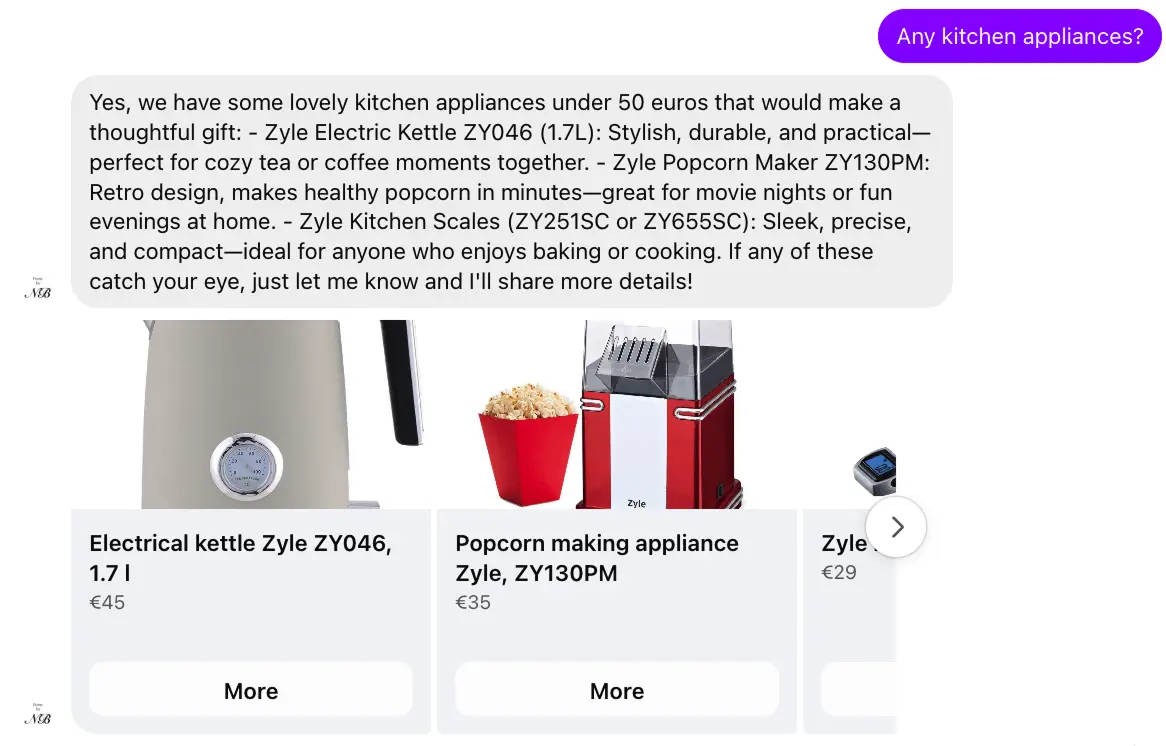
Built for e-commerce sales, not just support: Where ManyChat and Chatfuel are general-purpose, Parnidia is purpose-built to convert Meta conversations into sales. When a customer chats via Instagram or Facebook, the assistant doesn't just answer questions – it sends interactive product cards directly in the DM. Tap one, and the customer is taken straight to that product page on your e-commerce store. The chat becomes the start of a sales funnel, not just a text-only consultation.
Best for: E-commerce stores that want a working Meta DM automation without spending weeks setting it up themselves, and that prioritize sales conversion over the ability to customize every detail.
Worth knowing: Parnidia is not a flow-builder platform – if you want to design custom logic yourself, ManyChat or Zernio give you that. While Parnidia is purpose-built for e-commerce, where its product recommendation features and sales-funnel integration add the most value, the platform also serves other industries – service-based businesses, B2B companies, and clinics use it for customer support, lead qualification, and appointment workflows. The done-for-you model means less hands-on control, which is exactly the trade-off – you're paying for outcomes rather than tools.
The decision becomes much easier once you ask yourself the right question:
Not all “AI” in this category is created equal. ManyChat and Chatfuel both market AI features, but at their core they're rule-based platforms with AI capabilities bolted on. The “AI” usually means GPT-powered message drafting, keyword recognition, or basic intent matching – not true conversational AI that understands context across a long conversation.
Zernio doesn't supply AI at all – you bring your own model and define how it behaves.
Parnidia, by contrast, ships with conversational AI purpose-trained for e-commerce: it understands product questions, order inquiries, recommendations, and multilingual conversations natively, without you needing to build that logic yourself.
This isn't about which tool is “best” – it's about being honest about what each one delivers. If you need true AI conversations, that's a real differentiator. If you mainly need triggered marketing flows, the rule-based tools work fine.
There's no “best” tool for Meta DM automation in 2026 – only the best tool for your specific situation. The four-approach framework above is more useful than a feature comparison because it forces you to ask the question that actually matters: what kind of solution are you looking for?
If you want to build campaigns yourself with no code, ManyChat is the category leader. If your customers are exclusively on Meta and you want simplicity, Chatfuel still works. If you have developers and want unlimited flexibility, Zernio is the cleanest API on the market. If you run an e-commerce store and want a working Meta sales channel without setting up a platform yourself, Parnidia handles the integration end-to-end and turns DMs into measurable revenue.
The right question isn't which tool wins on paper. It's about which tool fits how you actually work and how much of the setup you want to own yourself.
Request a Parnidia demo here to see how done-for-you Meta DM automation works for your store.

Leo Mazzura
Co-founder & CEO @ Parnidia

Smarter support starts with a call.
Get in Touch

.webp)
